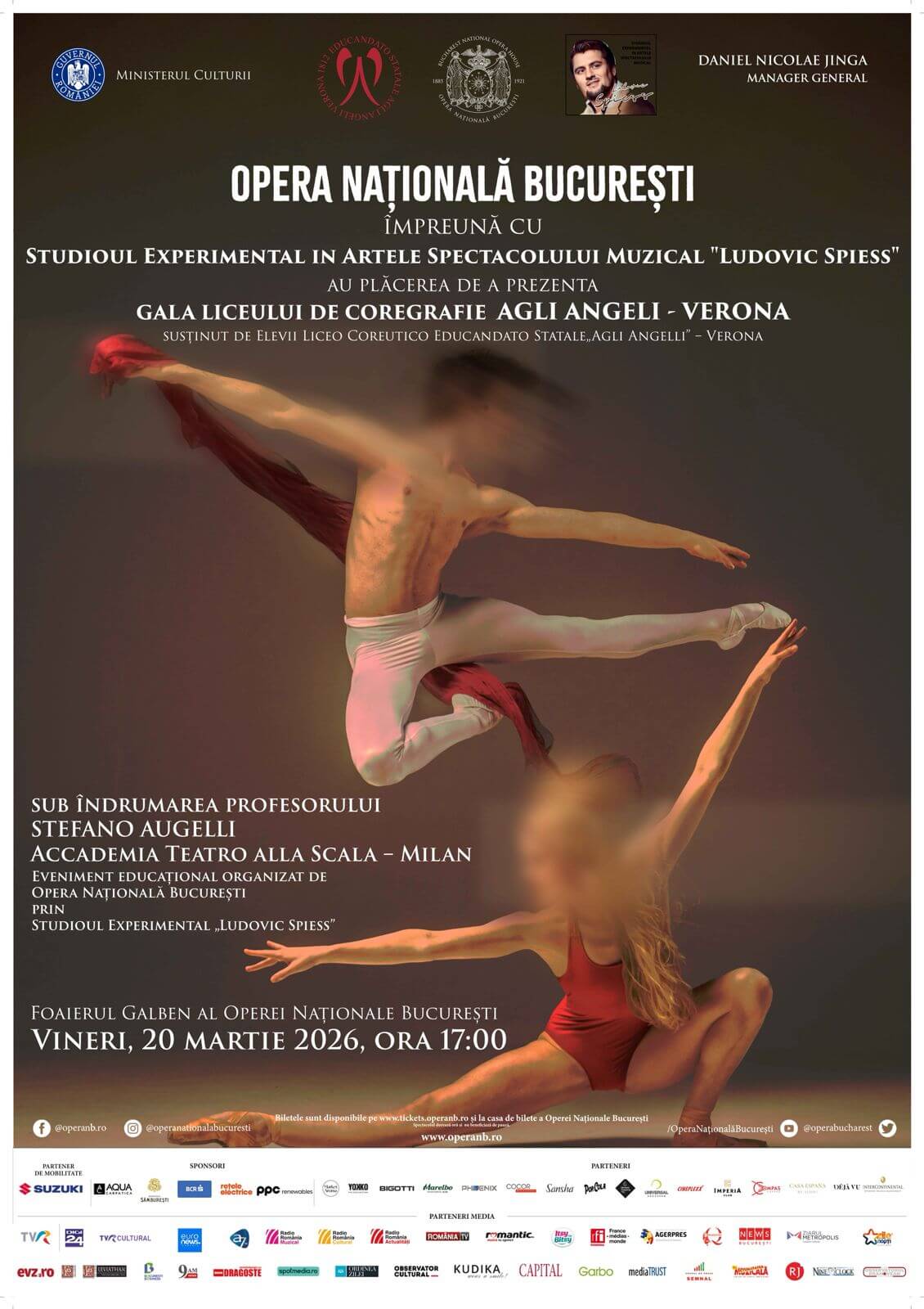
Sursă foto: Facebook – Revolve Dance
Pe 24 august 2025, scena Operei Naționale București a găzduit un eveniment de excepție: cea de-a VIII-a ediție a galei internaționale Stars Gala by Revolve Dance, un spectacol devenit reper pentru iubitorii de balet și dans contemporan din România.
Ediția din acest an a răsfățat publicul cu un program de gală spectaculos, reunind pe aceeași scenă nume consacrate ale baletului mondial și tinere talente aflate în plină ascensiune. Printre invitații de onoare s-au numărat Luca Doboș și Anastasia Lukina de la prestigiosul Teatrul Mariinsky, care au fermecat spectatorii printr-un fragment din celebra suită Frumoasa din pădurea adormită. Lor li s-au alăturat Rebecca Rudolf și Alfie Pearce de la Bayerisches Staatsballett München, într-un duet impresionant din Carmen pe coregrafia legendarului Roland Petit, moment prezentat în cadrul proiectului Centenaire Roland Petit.
Gala a inclus și o secvență de forță din baletul Spartacus, inspirată din coregrafia originală a lui Leonid Yacobson, care a electrizat sala.
Un punct culminant al serii a fost, fără îndoială, momentul interpretării de către Carlotta de Mattei și Emmanuel Ippoplito a dansului “Duende”. Coregrafia a evidențiat contrastul dintre forță și fragilitate, iar precizia și muzicalitatea interpreților au făcut ca momentul să fie aplaudat îndelung de către public.
Spectacolul i-a celebrat și pe ambasadorii Revolve Dance, balerinii Alecsia Lăzărescu și Fabrizzio Ulloa Cornejo (Royal Ballet School, Londra), câștigători ai prestigiosului Prix de Lausanne, care au adus pe scenă grația și rafinamentul duetului Rhapsody, în coregrafia lui Sir Frederick Ashton.
De asemenea, programul a inclus și momente interpretate de tinerele stele ale baletului internațional, elevi ai celor mai importante școli de dans din Europa și Statele Unite: Rebeca Zamfir, Marius Mabda și Călin Garaicu (European School of Ballet, Amsterdam), Betty Pan (SUA), Emma Nănău (School of the Hamburg Ballet), Ariana Sitaru și Ioana Săvulescu (John Cranko Schule, Stuttgart). Lor li s-au alăturat și alți tineri dansatori premiați la concursuri internaționale precum Youth America Grand Prix și Prix de Lausanne.
Din culisele Duende: interviuri cu Nacho Duato și Carlotta De Mattei

Nacho Duato: „Coregrafia mea e simplă — și tocmai de aceea e dificilă: se vede fiecare greșeală”
„It was a great experience, I felt the dancers improved day by day and started to get more familiar with my movement. The choreography is so simple, but because it is so simple, that is what makes it difficult, as you can see every mistake. What I wanted to do in my choreography is to translate what I feel when I hear the music. To me, it is like entering through a forest and you are observed by creatures that you don’t see. You have feelings that come into your mind or your body. You feel something is going on behind that nature, something that is invisible. Indeed, now it has been more than 30 years and the work still captivates the audience, the dancers love to do it. It feels very rewarding, I am very happy and it is nice to live through my work year after year after year. I hope I will go back to Bucharest one day and do a whole piece or a full evening.”
Carlotta de Mattei: „Duende mi-a deschis o nouă cale spre a-mi exprima emoțiile, prin mișcare pură”
Sabin Codreanu: We know that Duende is not based on characters. It does not follow a narrative story, but rather expresses emotions and feelings through the movements themselves. How did you find this choreography in comparison to other works you’ve performed?
Carlotta de Mattei: It was my first time working on a Nacho Duato piece, and I have to say I loved every second of it. Having the privilege to work directly with the choreographer himself was incredibly special—he explained each step in detail, sharing not only the movement but also the intention and meaning behind it. That experience was truly inspiring.
Duende is a brilliant work, choreographed in shapes rather than characters or narrative, which at first felt quite challenging since it was so different from the other pieces I had performed. But through the process, I learned so much, and it opened my mind to a new way of expressing emotions through pure movement. I’m really looking forward to dancing it again!
Sabin Codreanu: „Duende” is that feeling that makes people get moved by art, impressed, emotional sometimes. Today’s public round of applause really showed this, they were moved by this performance. What is one moment from your career in which art really made you happy or emotional?
Carlotta de Mattei: There have been several moments in my career where art and passion made me incredibly happy and emotional, but one that stands out is when I danced the Nutcracker pas de deux a few years ago in Catania. The stage was beautiful, and the atmosphere was magical, but what touched me the most was seeing young kids in the audience light up with excitement. It was such a wholesome experience seeing them getting inspired, coming up afterward to ask for advice. It reminded me so much of myself when I was their age, looking up to dancers myself with the same spark in my eyes. That connection felt very sweet and meaningful, deeply moving—it really stayed with me.
Sabin Codreanu: Duende premiered in 1991, blending classical ballet with a contemporary dance style. How do you find this fusion when you dance on stage?
Carlotta de Mattei: Dancing Duende feels like such a unique experience. Nacho Duato is a genius—he draws inspiration from music and really sees beyond the obvious. I find it fascinating how he can “play” with movement, combining and blending two completely different styles in one piece. On stage, I feel the freedom of contemporary movement flowing through me, while still holding on and honoring the technique, the precision and clean lines of classical ballet. It’s a beautiful balance, and letting my body explore both sides at once is both challenging and incredibly fulfilling and rewarding.